

TLDR: Oxidative stress during exercise is the temporary imbalance between free radicals your body makes when you train and the antioxidants that neutralize them. Some of that stress is useful for fitness gains, but too much with too little recovery can drag down performance, slow recovery and impact your skin, which is why thoughtful habits and targeted antioxidants can help.
When you start taking your training more seriously, you also start noticing how much recovery matters. You may be hearing about “oxidative stress” and “antioxidants” from every coach, creator and supplement brand, without anyone really explaining what that means for your body and skin. This guide breaks down what oxidative stress during exercise actually is, how it connects to fatigue, soreness and your complexion, and what is worth focusing on in your daily routine. You will walk away with a clear picture of what is happening inside your cells and a realistic plan to support your own antioxidant defenses.
What is oxidative stress during exercise?
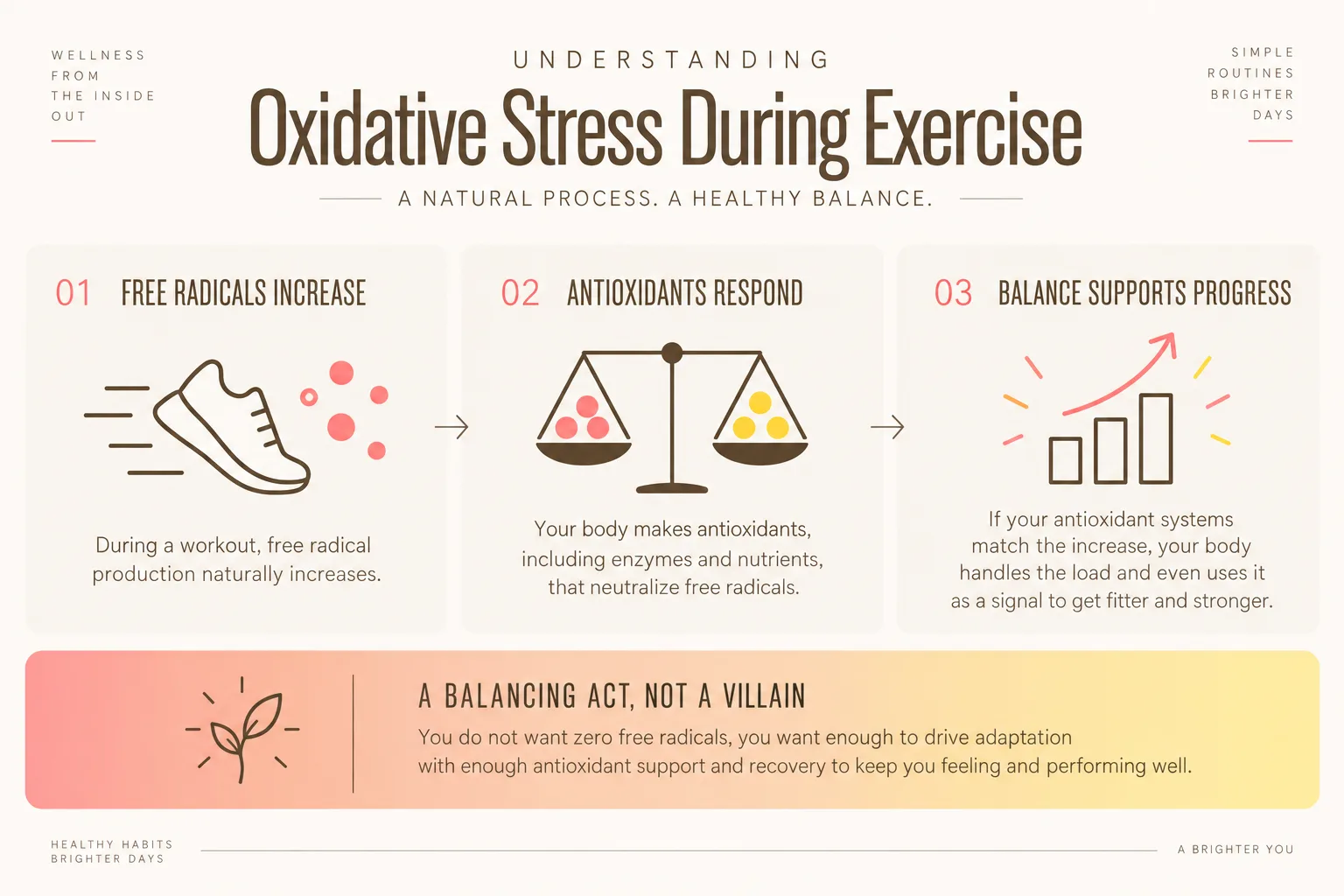
Oxidative stress during exercise is what happens when your body produces more free radicals than your antioxidant defenses can comfortably keep up with in that moment.
Free radicals are reactive molecules, often made from oxygen, that can interact with cell structures like fats, proteins and DNA. Your body also makes antioxidants, including enzymes and nutrients, that neutralize these free radicals and keep them in check.
During a workout, free radical production naturally increases. If your antioxidant systems match that increase, your body handles the load and even uses it as a signal to get fitter and stronger. Oxidative stress becomes a concern when this balance tilts for too long toward free radicals and your cells stay under more pressure than they can repair from efficiently.
It is important to see oxidative stress as a balancing act, not a villain to eliminate. You do not want zero free radicals, you want enough to drive adaptation with enough antioxidant support and recovery to keep you feeling and performing well.
If you want a refresher on antioxidants in general, you may find it helpful to read our overview of what antioxidants are and how they affect the body.
What happens in your body during a workout? (Free radicals, antioxidants and inflammation)?
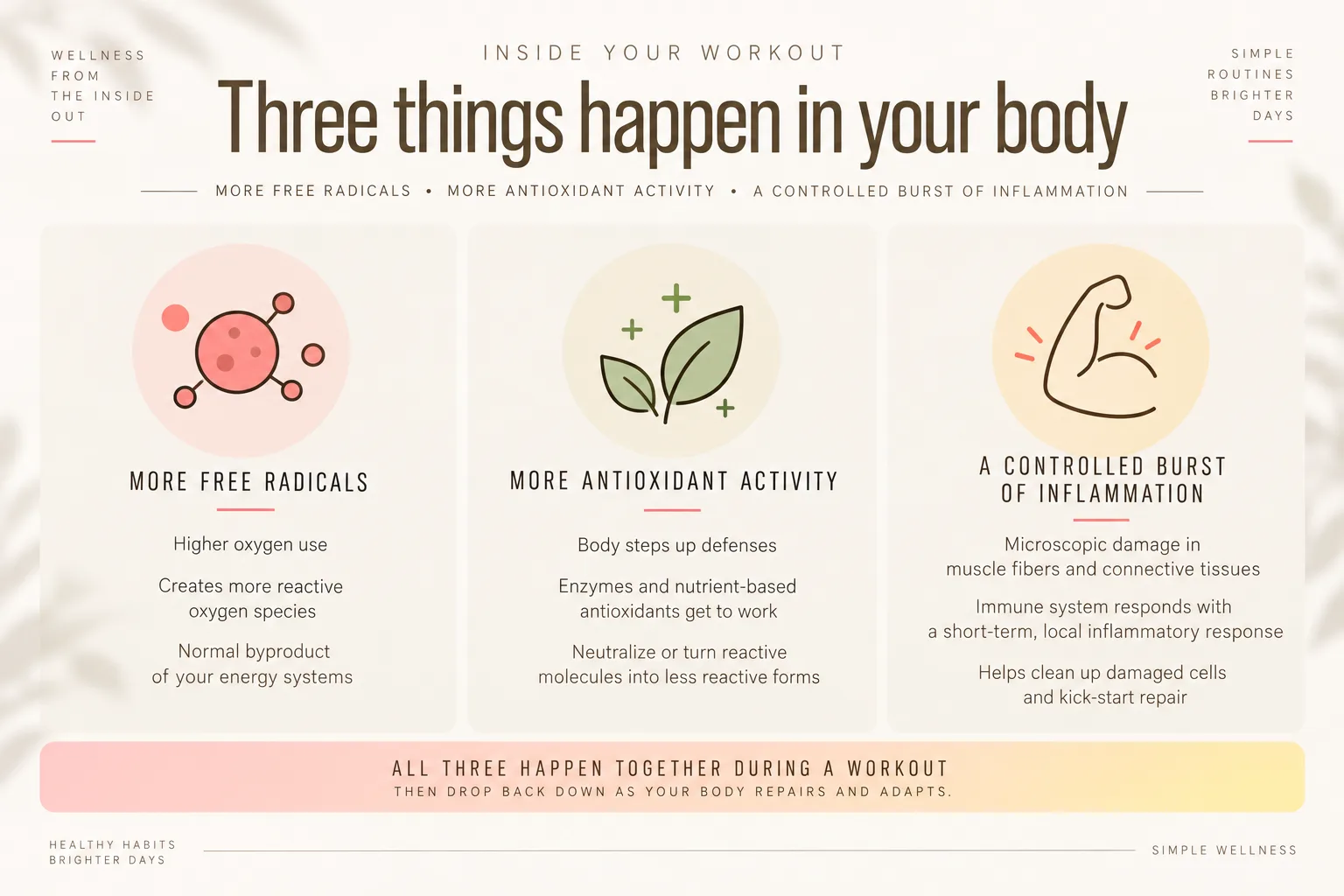
When you start exercising, your muscles demand more energy, so your breathing and heart rate rise and your cells burn more oxygen for fuel.
That higher oxygen use in working muscles naturally creates more reactive oxygen species, which are a type of free radical. These are normal byproducts of your energy systems kicking into a higher gear, especially in harder or longer sessions.
In response, your body steps up its antioxidant defenses. Enzymes and nutrient-based antioxidants get to work neutralizing many of these reactive molecules or turning them into less reactive forms your cells can handle more easily.
Training also creates microscopic damage in muscle fibers and connective tissues. Your immune system responds with a short-term, local inflammatory response to help clean up damaged cells and kick-start repair. In a healthy cycle, this wave of inflammation and oxidative activity rises during and after your workout, then drops back down as your body repairs and adapts.
So during a single workout, you have three main things happening together inside your body: more free radicals, more antioxidant activity and a controlled burst of inflammation. How you feel in the days after is influenced by how smoothly that rise and fall happens.
Is oxidative stress during exercise good or bad?
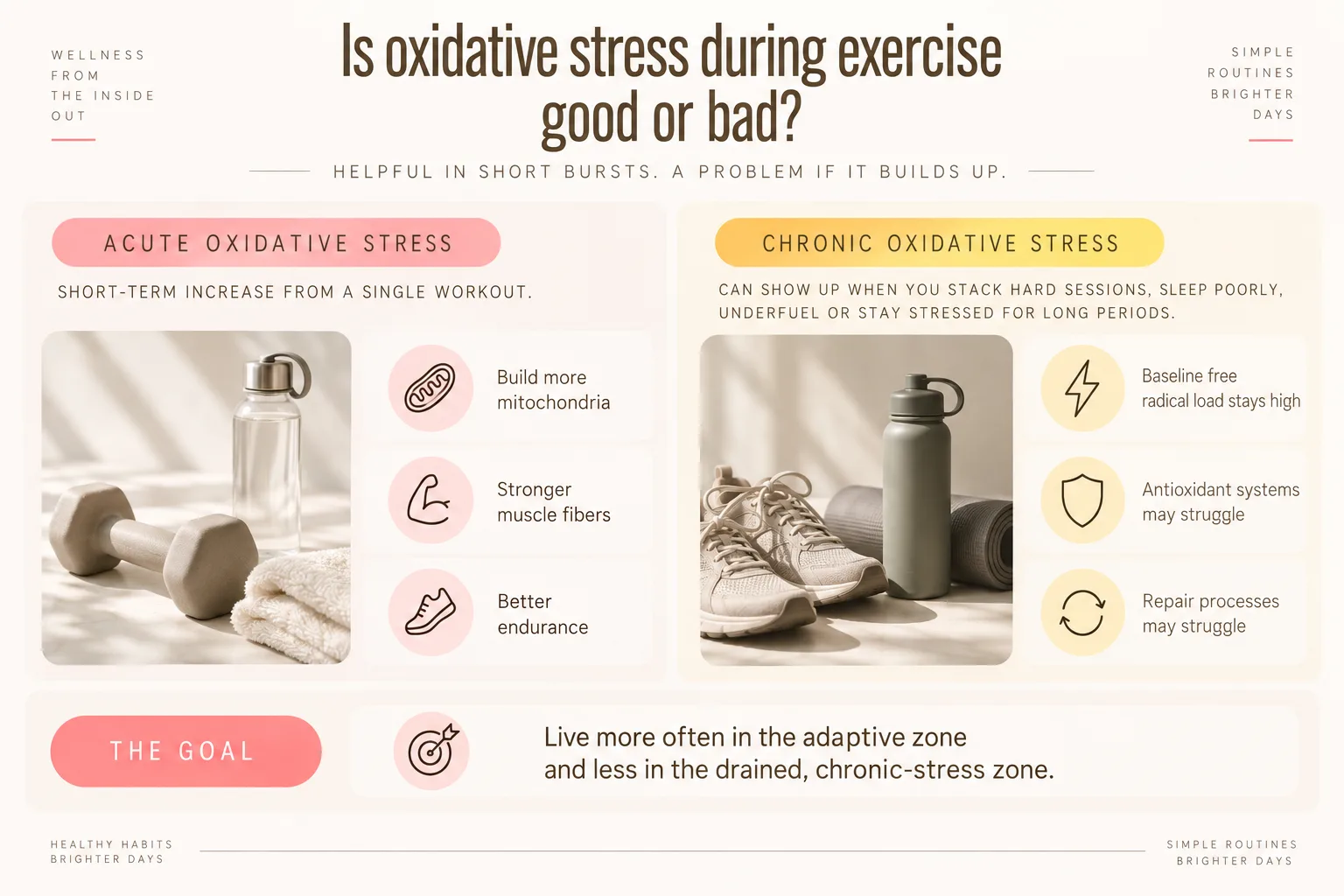
Oxidative stress during exercise is helpful in short bursts, but too much over time without recovery can become a problem.
Acute oxidative stress is the short-term increase from a single workout. This is part of what signals your body to build more mitochondria, stronger muscle fibers and better endurance. That is one reason training consistently over weeks and months makes you fitter.
Chronic oxidative stress is the pattern that can show up when you stack hard sessions on top of each other, sleep poorly, underfuel or stay mentally and physically stressed for long periods. In that state, your baseline free radical load stays high and your antioxidant systems and repair processes may struggle to keep up.
On the helpful side of the spectrum, you feel challenged during workouts but recover well, and your performance trends up. On the unhelpful side, you feel like every workout is a grind, small niggles linger and your skin looks more tired or dull.
Your goal is not to “turn off” oxidative stress. It is to live more often in the adaptive zone and less in the drained, chronic-stress zone.
How oxidative stress shows up: performance, recovery and even your skin
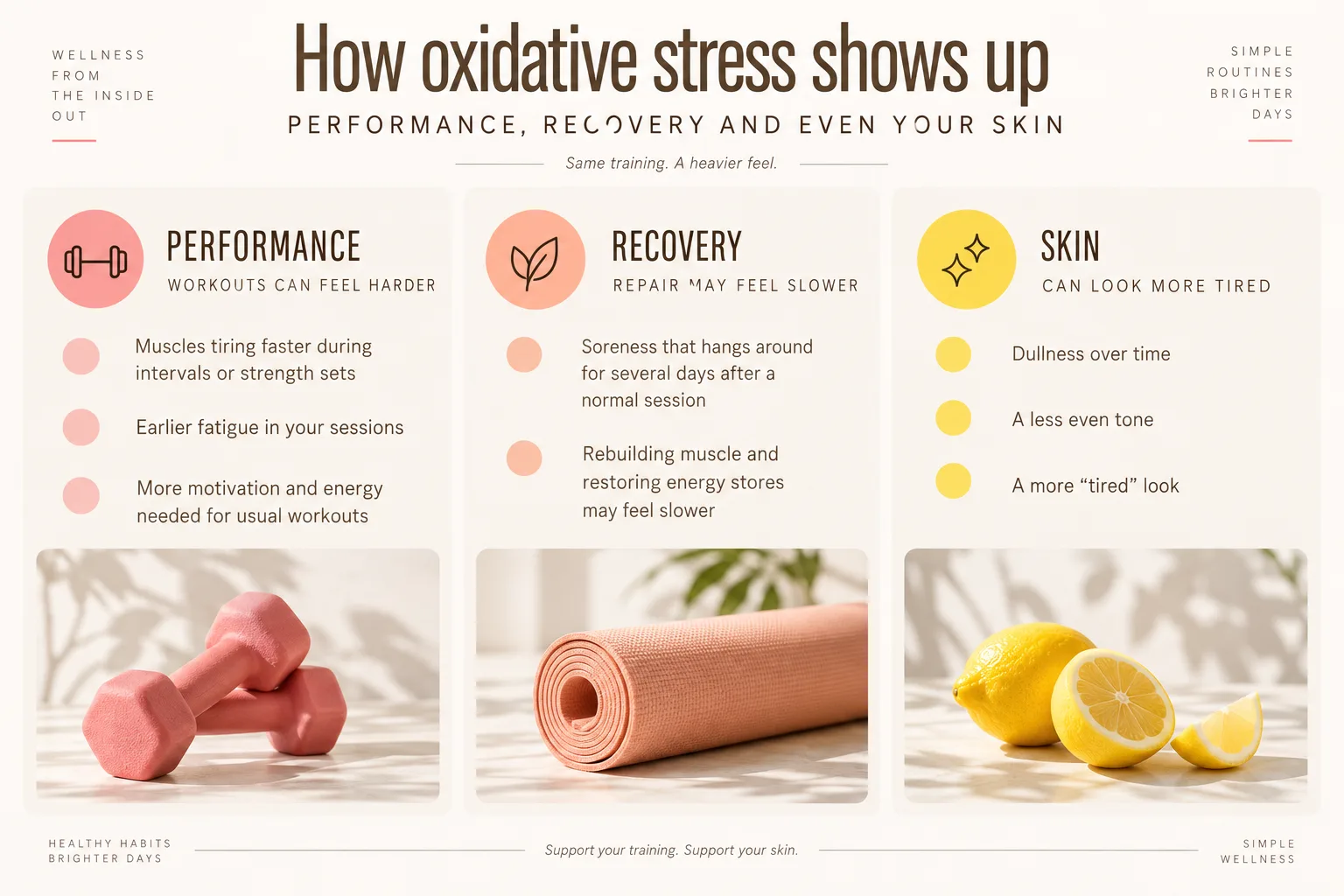
Oxidative stress can show up in your workouts as heavier legs, earlier fatigue and that feeling that sessions take more out of you than they used to.
When free radicals and inflammation stay elevated longer than your body prefers, you may notice:
- Muscles tiring faster during intervals or strength sets
- Soreness that hangs around for several days after a normal session
- A general sense that it takes more motivation and energy to get through your usual workouts
On the recovery side, oxidative stress can influence how quickly your tissues repair. If your body is playing catch-up on cellular damage, rebuilding muscle and restoring energy stores may feel slower, especially if sleep and nutrition are not dialed in.
Your skin is also affected because it is made of cells facing both internal and external stressors. Internally, oxidative stress can influence collagen and elastin structures, natural hydration and how your skin responds to everyday exposure. Externally, sunlight, pollution and lifestyle all add to the oxidative load your skin has to handle.
Over time, that mix can show up in the mirror as dullness, a less even tone or a more “tired” look, especially when you are training hard without consistent recovery habits to match.
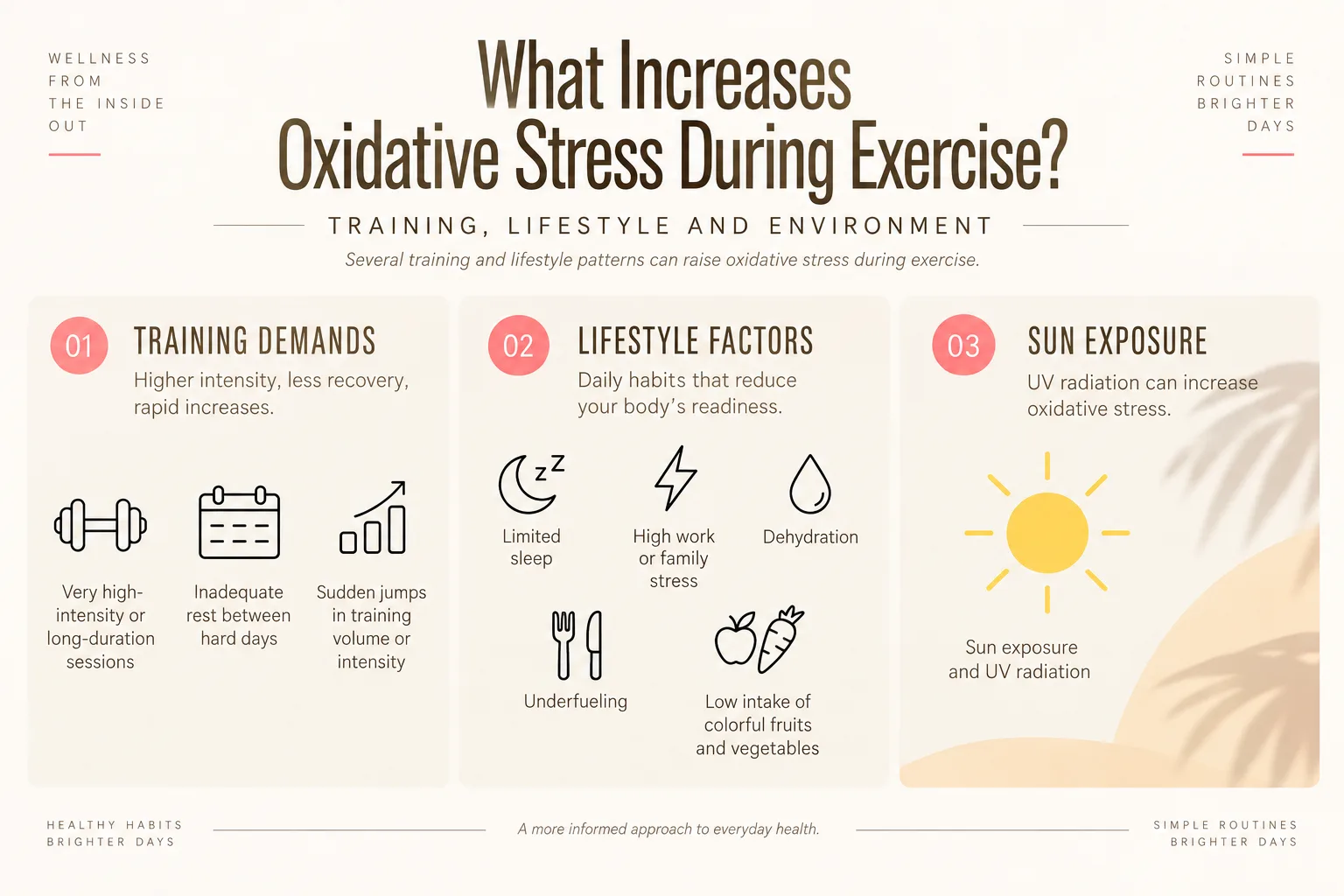
What increases oxidative stress during exercise? (Training, lifestyle and environment)
Several training and lifestyle patterns can raise oxidative stress during exercise, and understanding them helps you decide what to adjust.
Very high-intensity or long-duration sessions increase your oxygen use and, with it, reactive oxygen species. That is true for long runs or rides and also for hard interval days or heavy lifting with short rest.
Inadequate rest between hard days adds up. If you stack multiple intense sessions without easier days or deload weeks, your body may still be dealing with the oxidative and inflammatory effects of one workout when you hit it with another.
Sudden jumps in training volume or intensity, like doubling your weekly mileage or adding several extra classes at once, can also spike oxidative stress. Your body did not have time to build up antioxidant defenses and structural adaptations for that new load.
Outside the gym, lifestyle factors layer on top of your training choices. Limited sleep, high work or family stress, dehydration, underfueling and a low intake of colorful fruits and vegetables can all reduce how ready your body is to handle the oxidative load of a workout.
Sun exposure and UV radiation can increase oxidative stress for skin and the body, but sunlight itself is also healthy and beneficial in moderation. Natural light helps with mood and energy, and avoiding all sun is neither realistic nor necessary.
Moderate, smart sun exposure supports vitamin D production, circadian rhythm and mood, so the message is not that the sun is bad or something to fear. It is about finding a balanced approach alongside other oxidative stress factors, like timing your outdoor workouts, using protection when UV is strongest and treating sun as one variable in your overall recovery picture rather than the enemy.
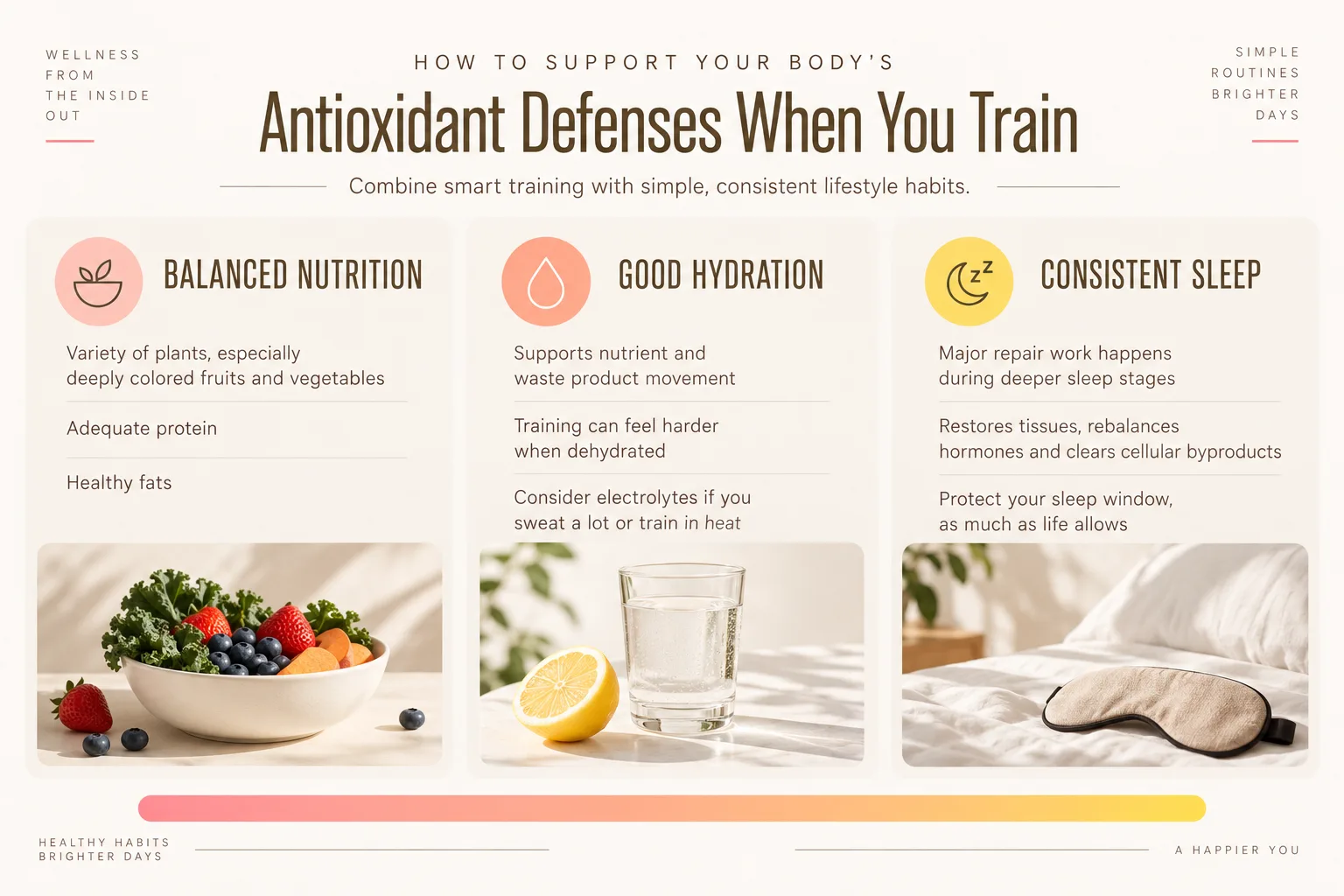
How to support your body’s antioxidant defenses when you train
You support your body’s antioxidant defenses best by combining smart training with simple, consistent lifestyle habits.
Balanced nutrition is a foundation. Eating a variety of plants, especially deeply colored fruits and vegetables, supplies vitamin-based and plant-based antioxidants along with fiber and minerals. Adequate protein supports muscle repair and the enzymes involved in many cellular defense systems, and healthy fats help with hormone health and absorption of certain nutrients.
Good hydration matters because your blood, lymph and cellular fluids are how nutrients and waste products move. Training in a mildly dehydrated state can feel harder, and recovery may feel slower when circulation and fluid balance are off. Paying attention to both water and electrolytes is useful if you sweat a lot or train in heat.
Consistent sleep is where a large part of your repair work happens. During deeper sleep stages, your body carries out many of the processes that restore tissues, rebalance hormones and clear cellular byproducts. Protecting your sleep window, as much as life allows, is one of the most powerful ways to support your own antioxidant systems.
From a training perspective, rotating hard and easy days, building volume gradually and planning deloads help keep oxidative stress in that adaptive sweet spot. Listening to markers like lingering soreness, mood and motivation gives you clues about whether your current load is sustainable for your body.
If you want to go deeper on how specific antioxidant systems work, including primary enzymes, our breakdown of SOD and primary antioxidants walks through that science in more detail.
Superoxide dismutase (SOD) and SOD B®: what the research actually shows
Your body makes its own superoxide dismutase (SOD), one of the enzymes that helps manage free radicals created during hard training. Some drink mixes also include a plant-derived SOD concentrate as an added support tool.
SOD B® is an antioxidant ingredient from French Charentais melon juice concentrate, standardized for superoxide dismutase activity. Human research on a daily melon SOD concentrate around intense exercise has looked at physical well-being, fatigue and markers related to oxidative defense. Our overview of SOD B® and recovery summarizes how that work is described for active people.
That study is one supplier-funded trial, not a guarantee of personal results. It does support the idea that a daily melon SOD concentrate can sit alongside training, sleep and food as part of how active people manage recovery. Preclinical animal work and informal athlete observations exist too, but those are not the same as human trial evidence, so we keep them separate.
You can also read more about how this ingredient shows up in our formulas in our deeper dive on SOD B® and recovery.
Where SkinSips® fits in an oxidative-stress-conscious routine
SkinSips® makes antioxidant drink mixes for people who care about training, recovery and how their skin looks and feels.
SkinSips® Lemon is powered by SOD B® Melorun® as its SOD ingredient.
SkinSips Plus® Strawberry Lemonade Flavored 20 Pack uses SOD B® as its SOD ingredient. SOD B® is the branded ingredient name for the SOD-rich French melon concentrate that supplies SOD B® in the formula, not the biological source of SOD itself.
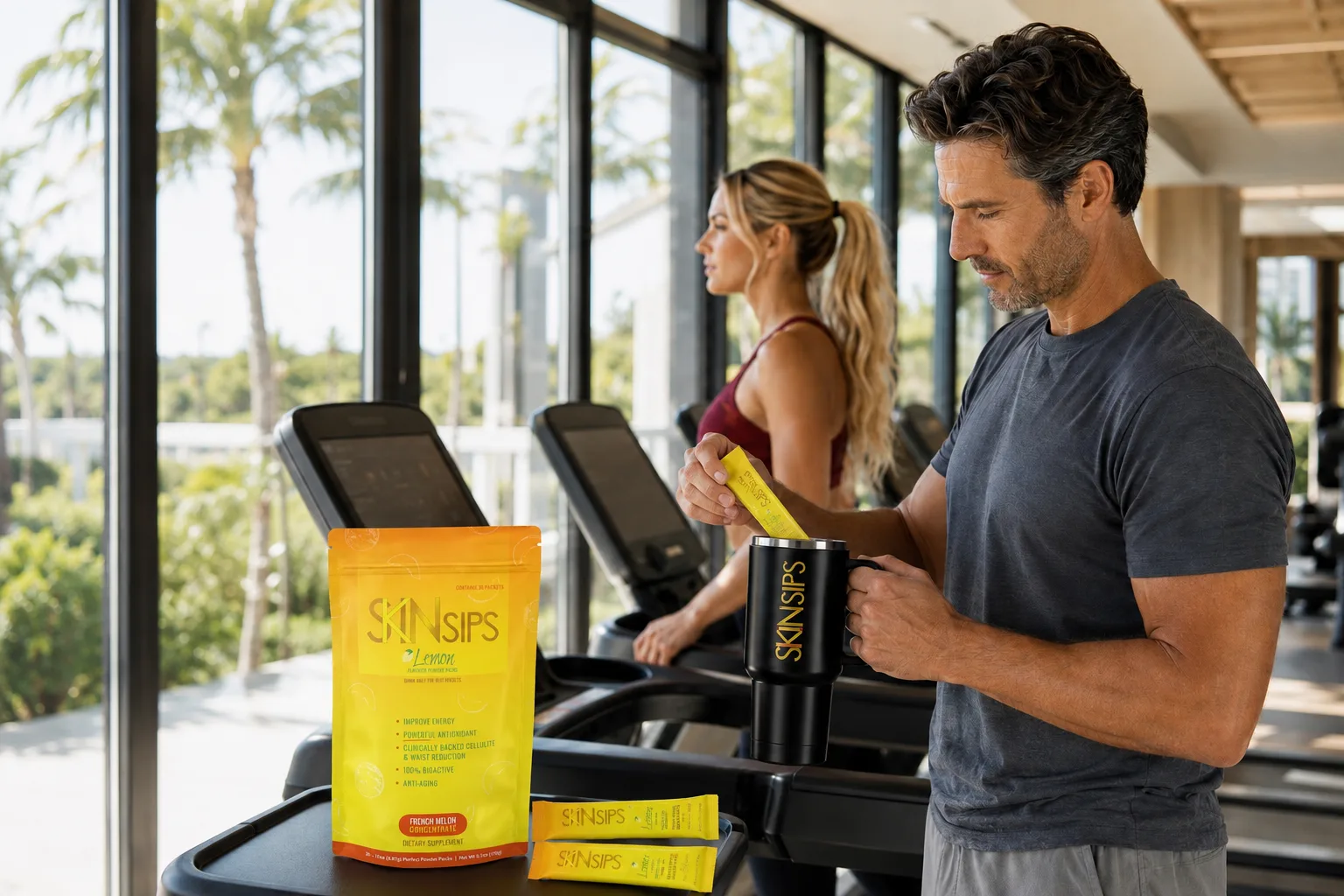
SOD B® in SkinSips Plus® is typically used daily as part of recovery and skin care, not as a one-workout fix.
Across all products, SkinSips® drinks are plant based, non GMO, sugar free, caffeine free, have no artificial flavors, are vegan and gluten free, and are made in the USA. As a women owned business with an all female team led by Mary Rankin we focus on formulas that respect how women actually train and recover, not just what looks good on a label.
If you want more on the specific science behind our recovery-focused formula, our SkinSips Plus® science page breaks down how SOD B®, magnesium, electrolytes and L-theanine were selected.
Putting it together: a realistic approach to oxidative stress and exercise
Oxidative stress during exercise is natural and part of how your body gets fitter, but managing it makes a real difference in how you feel during workouts and how you recover.
You do not need to chase perfection or fear every hard session. Focus on smart programming, food that genuinely nourishes you, hydration, sleep you protect as best you can and a balanced relationship with sun and other everyday stressors.
Then, if it fits your goals and lifestyle, layering in antioxidant-focused support designed for active women can be a practical way to back up the work you are already doing in the gym and in your kitchen. When you keep the big pieces in place and choose extras that respect the science, you give your body the best chance to adapt, perform and glow over the long term.
FAQs
How does oxidative stress affect workout recovery?
Oxidative stress can slow workout recovery when it stays elevated longer than your repair systems can handle. That may show up as lingering soreness, heavier-feeling muscles and more fatigue between sessions. Managing sleep, nutrition, hydration and training load helps your body move from stress back into repair more efficiently.
Can oxidative stress from exercise affect your skin?
Yes, internal oxidative stress from exercise adds to the overall load your skin manages along with sun, pollution and lifestyle. Over time, that combined stress can influence how bright, even and firm your skin looks. Supporting antioxidant defenses and recovery helps your skin cope better with both workouts and daily exposure.
What increases oxidative stress during exercise?
High-intensity or long-duration workouts, inadequate rest between hard days and sudden jumps in training volume increase oxidative stress. Sleep debt, underfueling, dehydration and high life stress make it harder for your body to handle that load. Sun exposure and UV radiation also raise oxidative stress for skin and the body, which is why balanced protection and smart sun habits matter.
How can you support antioxidant defenses when you train?
You support antioxidant defenses by eating antioxidant-rich foods, getting enough protein and healthy fats, staying hydrated and protecting your sleep. Programming training with a mix of hard and easy days also keeps stress in a productive range. Some people choose targeted antioxidant drink mixes designed for active recovery as an additional tool.
To build a routine that respects your training, recovery and skin, you can explore our full range of antioxidant drink mixes and flavors when you are ready: Shop SkinSips®.
*This article is general information, not medical advice. Talk to your doctor before changing your diet or supplements.*